
Adaptive mesh hyper-reduction for ROMs
Reduced-order models cut cost by reducing the number of unknowns. But for nonlinear problems, assembling the reduced system still requires visiting every element of the original mesh — which can dominate the total cost. Hyper-reduction addresses this by solving the ROM on a coarser mesh.
The approach here uses an adaptive mesh refinement (AMR) strategy driven by an a posteriori error estimator. Rather than uniformly coarsening the mesh, it identifies where the solution varies strongly and keeps resolution there, coarsening everywhere else. This gives controlled accuracy at minimal cost.
Results
Backward-facing step at Re = 20,000 — a challenging benchmark with flow separation and reattachment. The geometry is simple but the flow is complex: a shear layer develops at the step, breaks down into vortices, and reattaches further downstream. The full model uses ~62,000 elements. The three rows show FOM, ROM, and hyper-ROM results at t=50.
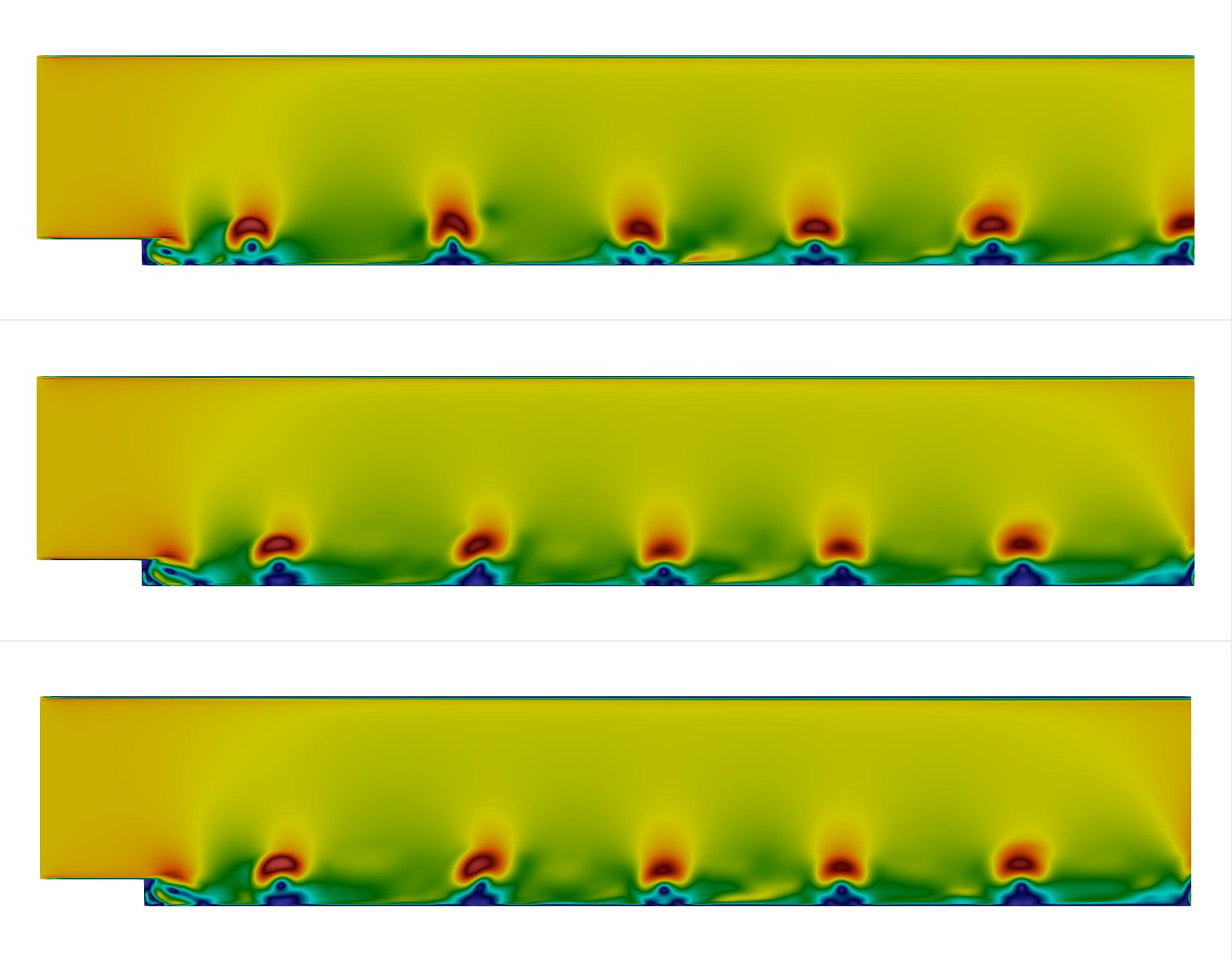 Velocity field: full simulation (top), ROM (middle), hyper-ROM (bottom).
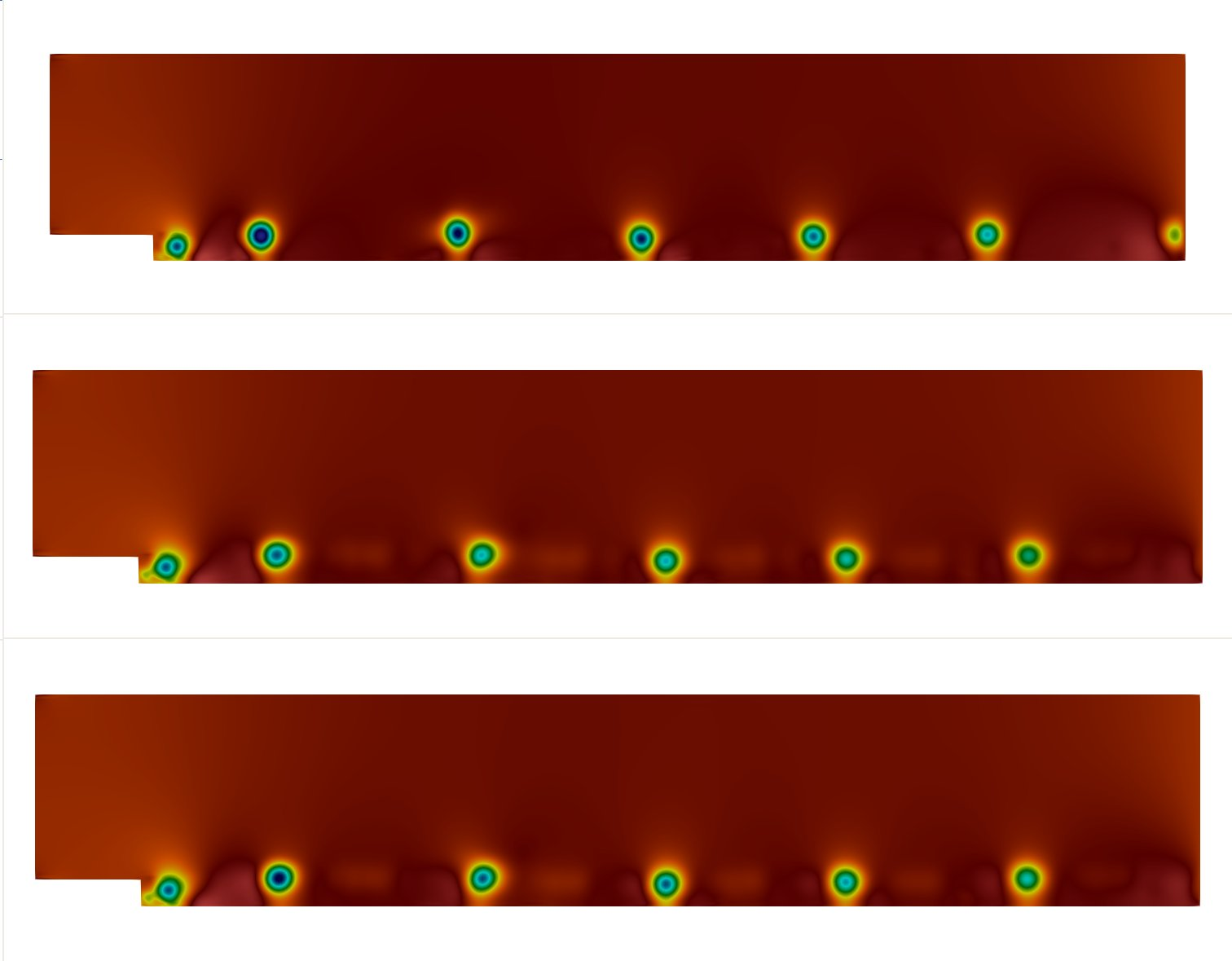 Pressure field: full simulation (top), ROM (middle), hyper-ROM (bottom).
The ROM runs at 14% of the full simulation cost. The hyper-ROM drops this further to 8%.
Differentially heated cavity — thermally driven flow where the error estimator concentrates mesh resolution near the hot and cold walls where thermal gradients are steepest, coarsening the mesh from 80,000 to roughly 10,000 elements.
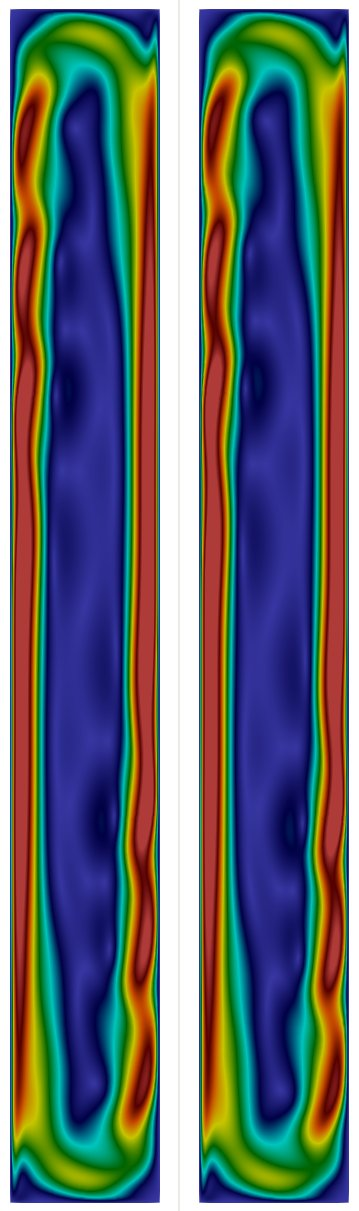 Velocity | 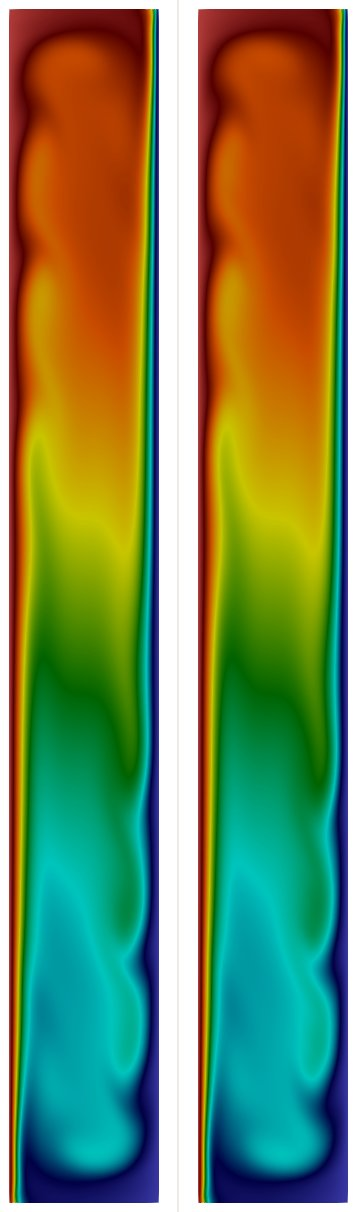 Temperature |  Adaptive mesh |
Left to right: velocity field, temperature field, adaptive coarse mesh. Full simulation (left column in each) vs reduced-order model (right column).
Publications
R. Reyes, R. Codina, Element boundary terms in reduced order models for flow problems: Domain decomposition and adaptive coarse mesh hyper-reduction, Computer Methods in Applied Mechanics and Engineering, 368 (2020). DOI: 10.1016/j.cma.2020.113159
R. Reyes, R. Codina, J. Baiges, S. Idelsohn, Reduced order models for thermally coupled low Mach flows, Advanced Modeling and Simulation in Engineering Sciences, 5:28 (2018). DOI: 10.1186/s40323-018-0122-7