
Stabilized reduced-order models for incompressible flow
Projection-based reduced-order models compress expensive finite element simulations into a small set of modes using Proper Orthogonal Decomposition (POD). The idea is straightforward — but standard Galerkin projection onto a reduced basis inherits the instabilities of the underlying equations. For convection-dominated flows, this means the ROM either blows up or produces garbage without proper stabilization.
This work develops a Variational Multi-Scale (VMS) stabilization for projection-based ROMs that mirrors the stabilization used in the full finite element model. The key ingredients are orthogonal subgrid scales and time-dependent subscales, which together provide stability without introducing excessive dissipation. The stabilization parameters are derived consistently from the full model — no empirical tuning required.
Results
Flow past a cylinder at Re = 1000 — a standard benchmark with unsteady vortex shedding. The ROM reproduces velocity and pressure fields accurately with fewer than 30 modes from a full model of ~90,000 degrees of freedom.
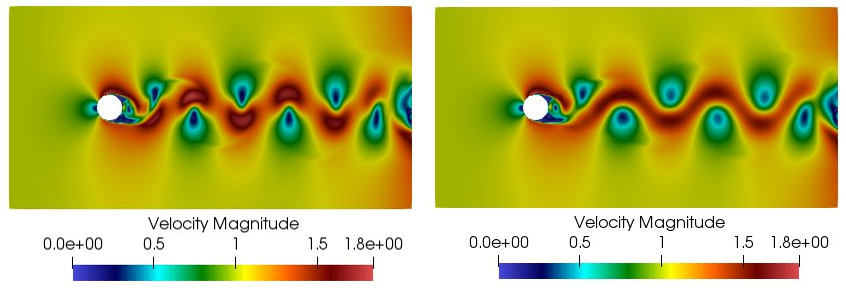 Velocity field at t=50: full simulation (left) vs reduced-order model (right).
3D flow past a twisted torus at Re = 1000 — a fully three-dimensional geometry with complex wake structure. The full model uses 743,810 degrees of freedom. The ROM captures the flow with 55 modes.
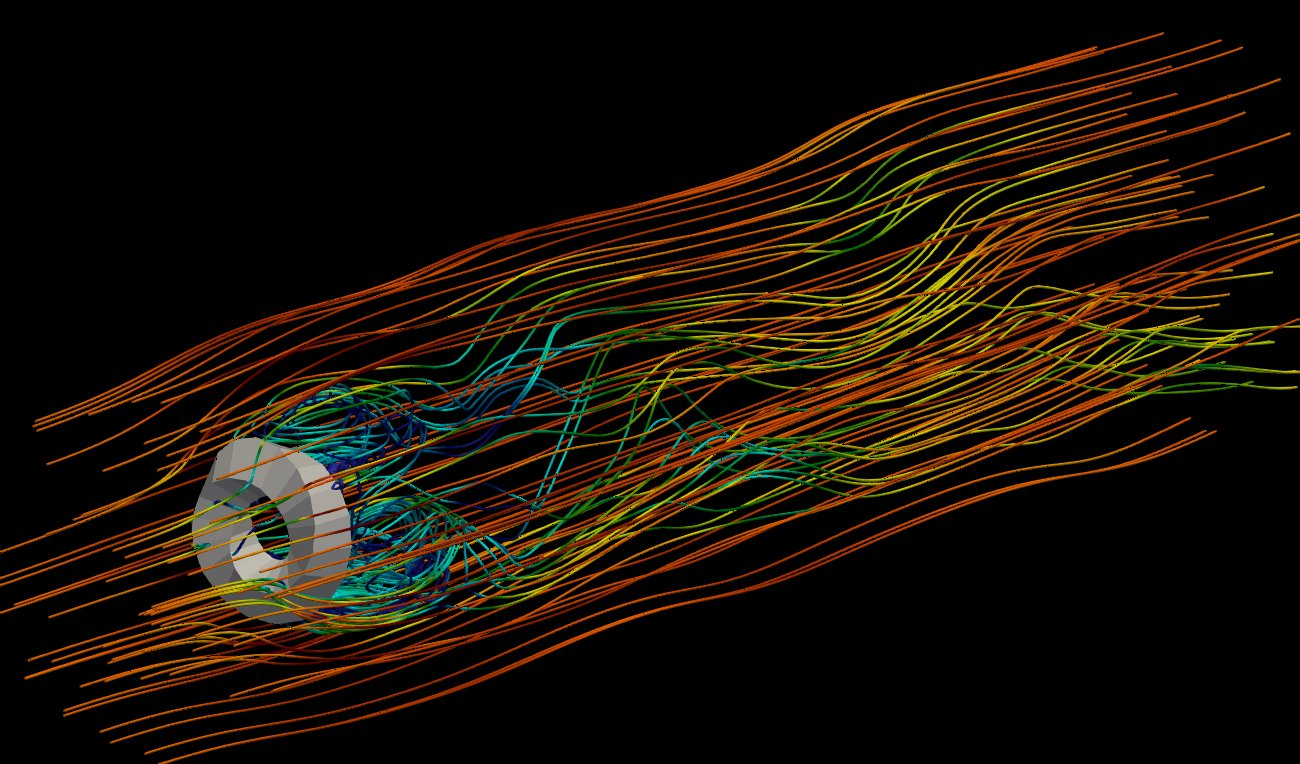 Streamlines coloured by velocity magnitude.
Publications
R. Reyes, R. Codina, Projection-based reduced order models for flow problems: A variational multiscale approach, Computer Methods in Applied Mechanics and Engineering, 363 (2020). DOI: 10.1016/j.cma.2020.112844
R. Reyes, R. Codina, Element boundary terms in reduced order models for flow problems: Domain decomposition and adaptive coarse mesh hyper-reduction, Computer Methods in Applied Mechanics and Engineering, 368 (2020). DOI: 10.1016/j.cma.2020.113159